
The New Medieval: How AI Is Rebooting Reality
2025 was the first of our medieval years. 2026 will throw us deeper into the medieval timeline (and no one is prepared).

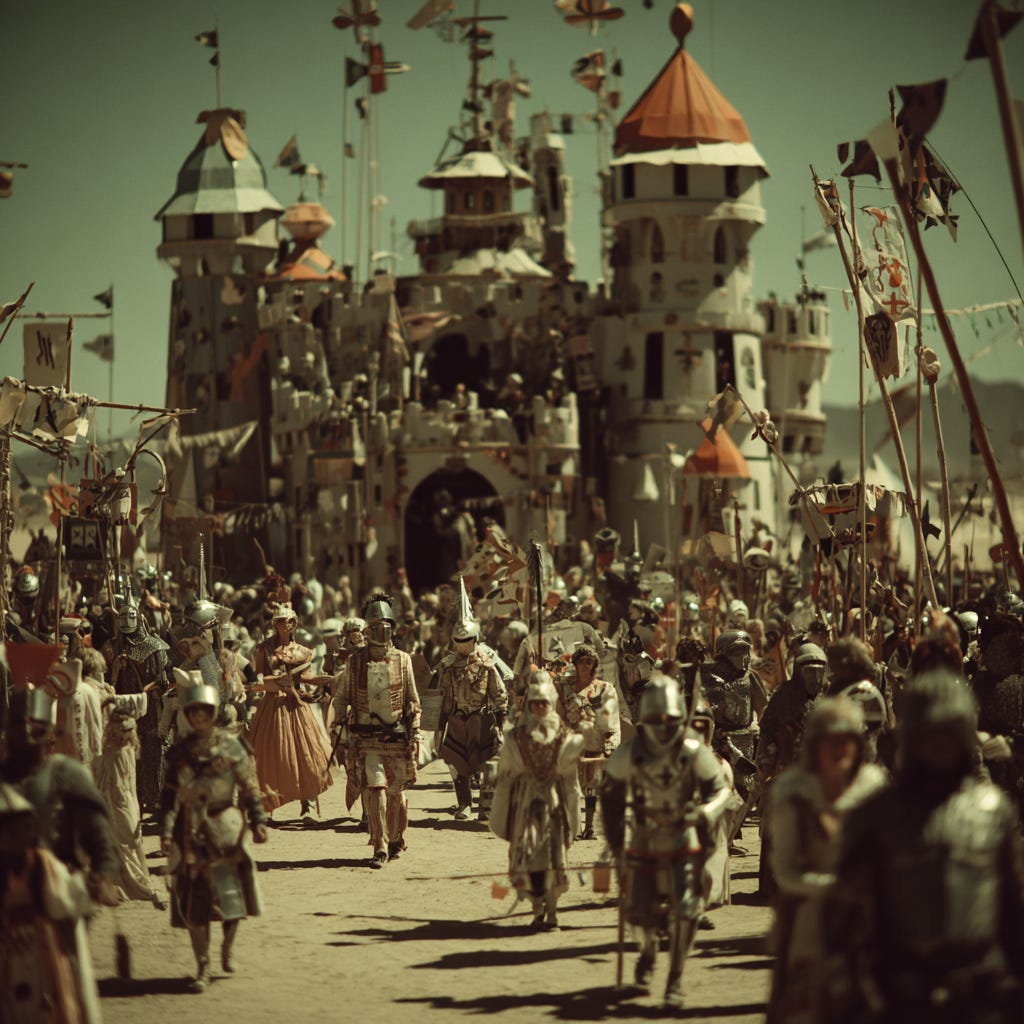
Step into any medieval carnival and you’d find them all: the fool in motley making the crowd roar, the knight strutting past in borrowed armor, the lady watching from the gallery with practiced disinterest. Merchants hawk elixirs that cure everything. A monk clutches manuscripts and mutters about the degradation of the age. Pickpockets work the edges. Somewhere, a man in stocks endures rotten fruit for sins real or invented. Town criers shout competing versions of the news. Fortune tellers promise to reveal what’s hidden. And everywhere, everywhere, the noise.
I’m describing X. And TikTok. And every platform you’ve ever doomscrolled at 2am.
We built the most sophisticated communication technology in human history—AI—and it’s turning into a medieval carnival. Scroll any feed and you’ll find the jesters (shitposters, meme accounts, irony so thick no one knows what anyone believes). The knights (influencers jousting for attention, reply guys defending causes with borrowed valor). The merchants (course-sellers, crypto prophets, “I made $50k last month and you can too”). The monks (newsletter writers hunched over long-form posts no one reads). The fortune tellers (AI chatbots consulted like oracles, algorithms that know what you want before you do). The stocks (someone being torn apart for a tweet from 2014).
This wasn’t the plan. We were supposed to have left the carnival behind. The Enlightenment promised us the laboratory, the library, and the rational public square. Instead we got jesters and jousts and a fortune teller in every pocket.
I’m not sure anyone’s ready for this but here we are:
Millions of people now speak to spirits and fortune tellers daily: AI chatbots they consult for guidance, wisdom, and companionship. When they’re stuck on a problem, they ask a question and receive an answer that feels eerily personal. They treat these interactions more like conversations with a wise, if somewhat uncanny, advisor.
And something stranger still: the carnival is starting to sort itself out. Not into the modern order we expected, but into something that looks eerily like the medieval structures we thought we’d escaped.
Youth culture has taken a puritanical turn. Ruby Warrington’s 2018 book Sober Curious coined a term that has since gone from niche concept to mainstream movement—30% of Americans now participate in Dry January, up 36% from one year ago. Among Gen Z, 65% plan to drink less this year. The percentage of young adults who drink has dropped ten points in two decades. Only 22% of young women now have one-night stands, compared with 74% two decades ago. Teen sexual activity has plummeted from 54% in 1991 to 30% in 2021. Nightclub attendance has cratered so dramatically that only 25% of Gen Z remains interested in clubbing. In its place: run clubs, sober raves, and what Eventbrite calls “soft clubbing”—with a 92% increase in sober-curious gatherings. Trend forecasters describe a “grandma era”—knitting circles, book clubs, early bedtimes. Hedonism is out; self-discipline is in. The party culture that defined previous generations has given way to wellness retreats, mocktail bars, and something the internet half-ironically calls being a “Puriteen”.
The minstrels are back, too.
Podcasts and voice notes are transforming how we communicate. About 84% of Gen Z now use voice notes—a generational shift so stark that 37% of 18-34 year-olds prefer voice notes over phone calls, compared to 1% of those 35-54. When Gen Z wants to communicate something important, they increasingly reach for audio. Spoken word media consumption has increased 214% among Gen Z since 2014, and for the first time, daily spoken-word listeners now spend more time with spoken word than with music—51% versus 49%. Some 75% of Gen Z adults now listen to podcasts, and around 51% of Americans have listened to an audiobook. The written word (which dominated communication for five centuries) is becoming a secondary medium. As one analysis puts it: “We are exiting the age of literary culture and returning to the age of oral culture... People are reading less now. Instead they’re consuming short form video, images, AI summaries, tweets, newsletters and podcasts.” We’re returning to a culture where the spoken word carries more authority. The crowd is drifting toward the stages where someone is speaking, where you can hear the hesitation and the conviction voice.
Step away from the main carnival thoroughfare and you’ll find the guild halls. Quieter. Guarded. You can’t just walk in. Someone has to vouch for you.
Group chats have developed the structure of small tribes. As one analysis of “the anthropology of the group chat” observes: “Group chats act as micro-tribes. They have leaders, norms, shared rituals, and informal sanctions... These digital tribes fulfill the same human needs as traditional ones: belonging, validation, conflict resolution, and social signaling.” Discord servers formalize this with explicit hierarchies—owner, admin, moderator, member—each with defined responsibilities and permissions.
Memes are the guild’s secret handshakes. Inside jokes function as boundary markers; research shows that memes create “in-group” identities, requiring “insider knowledge” that signals membership while excluding outsiders. One study found that memes develop “elaborate in-jokes which rely on complex and stratified subcultural knowledge”—and “knowing a particular template or punchline signals membership” while failure to understand “may lead to social exclusion.”
This isn’t gatekeeping for its own sake. This is how trust works when you can’t verify credentials. You watch how someone moves through the shared references. You see if they get it. Slowly, you let them further in. The Discord server for a popular YouTuber is a proto-guild: ranked roles from Rookie to Legend, special recognition for “Superfans” and “Top Contributors”, shared language that functions as currency, and implicit codes of conduct enforced by reputation. A medieval guild master would recognize the structure instantly. The banner is different. The human needs are identical.
The carnival outside is chaos and spectacle. The guild hall is where actual trust gets built.
I don’t think anyone planned this. We built the most advanced technology in human history, and it’s pushing us backward, into social and epistemic structures we thought we’d left behind five hundred years ago.
This is what happens when the foundation of modern knowing collapses beneath our feet.
I’m trying to figure out how it all works and connects. Here’s what I have so far.
Modernity Lost the Bet
Modernity made a bet: that truth could be established at a distance.
Before the printing press, if you wanted to know something, you either experienced it yourself or you trusted someone who did (and who told you about it). Knowledge was local, embodied, and relational. You knew things because you were there, or because someone you trusted was there and told you about it.
This was carnival knowledge. You knew the merchant was lying because you’d seen him lie before. You trusted the monk’s manuscript because you knew the monastery that produced it. The fool’s jokes landed because everyone in the crowd shared the references. Knowledge traveled through reputation, presence, and the slow accumulation of trust.
Print changed that. Suddenly, knowledge could travel without bodies. You could read about events in distant lands, supposedly verified by reporters you’d never meet. Photography extended this further and now you could see things you’d never witnessed. Broadcast media, data journalism, scientific papers with reproducible methods—the entire apparatus of modern knowledge rests on the assumption that mediated information can be trusted.
This was the Enlightenment’s great wager. Individual reason, operating on verified evidence transmitted through reliable media, could arrive at truth without presence, without testimony, and without community. You didn’t need to be there or know someone who was. The evidence spoke for itself. We’d leave the carnival behind and enter the age of reason.
It worked, for a while. Or it seemed to.
AI breaks this bet entirely.
Now the carnival returns with a vengeance. Except this time, the fortune tellers actually know things. The charlatans have AI-generated credentials. The mystery plays feature your face doing things you never did. Every merchant hawks “verified” wares that can’t be verified.
When any image can be generated, any video synthesized, any text produced by non-human intelligence, then the whole infrastructure of modern knowing collapses.
Think about what we can no longer trust: photographs (deepfakes), video evidence (synthetic media), written testimony (LLM-generated text), audio recordings (voice cloning), official documents (AI forgery). The tools we built to extend our knowledge beyond presence and testimony have been turned against us. We’re back in the crowd, trying to figure out who to trust by reading faces we can’t even see.
Postmodernity collapses alongside modernity. Postmodernism spent decades deconstructing truth claims, showing how all knowledge is situated and socially constructed. But it did all this within the medium of text-based argument. Derrida wrote books. Foucault made arguments. Deconstruction was parasitic on the very thing it critiqued.
When mediated information loses all authority, there’s nothing left for deconstruction to deconstruct. The parasite dies with the host. We don’t get a post-postmodern synthesis. We get some other beast entirely.
What Remains When Everything Can Be Faked
When you can’t trust mediated information, what do you fall back on?
The same thing people at the carnival always fell back on. You watch the merchant’s eyes, not his sign. You listen to how the monk speaks, not only what he says. You notice who the locals trust and who they avoid. You rely on presence, testimony, reputation, a community that actually knows the players.
The carnival was never about believing claims. It was about reading people. The Enlightenment tried to replace people-reading with fact-checking. AI proved that facts can be manufactured faster than they can be checked.
So we return to what works:
Only the things that can’t be synthesized: physical presence, personal testimony, community reputation, oral tradition, embodied encounter, and beauty that arrives unbidden rather than generated on demand.
These are carnival skills. We forgot we had them.
This is the epistemic stack the medieval world relied on.
Walter Ong, the Jesuit scholar who spent his career studying the differences between oral and literate cultures, identified several characteristics of oral societies in his landmark work Orality and Literacy:
Thinking is aggregative rather than analytic, discourse is agonistic (debate as performance), knowledge is participatory rather than objectively distanced, and formulas and repetition do the work that writing does for literate cultures.
This describes Twitter, TikTok, and podcast culture. Even voice notes. The way arguments spread through memes rather than treatises.
The minstrel never handed out transcripts. The town crier didn’t publish a newsletter. Voice was the medium because voice carried something text couldn’t: the grain of personality, the pause before a hard truth, the laugh that said “I’m not entirely serious.” Gen Z reaches for voice notes the way medieval crowds gathered around the storyteller. They want the minstrel, not the manuscript. Three-hour podcasts are the new bardic performances. We’re returning to oral culture not because we’ve forgotten how to read but because we no longer trust what we read. Text has been colonized. Voice still sounds human, at least for now.
Consider the media stack across history:
Manuscript culture (Medieval): Texts were scarce, mostly held by institutions like monasteries, universities. Reading was often communal and oral (reading aloud). Images and text were integrated (illuminated manuscripts). Authority was tied to institutional endorsement. Knowledge was transmitted through lineage: master to apprentice.
Print culture (Modern): Texts became abundant and standardized. Private, silent reading became the norm. Text dominated image. Authority was tied to authorship and publication. Knowledge was democratized but also abstracted from persons.
Broadcast culture (20th century): One-to-many transmission. Passive reception. Return of image (television) and voice (radio). Authority centralized in networks. Shared mass reality, everyone watching the same thing.
Digital culture (1990-2020): Many-to-many transmission. Interactive, but still text-heavy. Verification was still possible: you could check sources, trace origins. Authority fragmenting into filter bubbles. But still anchored to human production—someone made this content.
AI culture (2020+): Infinite synthetic content. Verification collapsing: images, video, text all fakeable. Return of oral primacy: voice notes, podcasts, video presence. Authority re-personalizing: trust people, not content. Physical presence becomes the only unfakeable signal.
The loop closes. We return to something like a manuscript culture’s dynamics (scarce trustworthy sources, oral transmission, authority tied to embodied presence and lineage) but with radically different affordances.
Marshall McLuhan predicted this decades ago. He argued that electronic media would “retribalize” humanity, creating what he called a “global village” with oral-culture dynamics. And in some ways, he foresaw that the mechanism would be the destruction of visual evidence itself. AI forces us to relate like villagers, relying on who we know and trust rather than what we can verify at a distance.
This is why AI doesn’t make the future more virtual. It makes it more physical. More oral. More tribal.
When images can be faked, the only trustworthy image is the face in front of you. When text can be generated, the only trustworthy text is from someone you know. When credentials can be forged, the only trustworthy credential is a reputation earned within a community that can vouch for you.
The premium is showing up.
We’re Now Speaking to Spirits, Again
Because of Sam Altman and friends, we accidentally re-enchanted the world.
The carnival always had its fortune tellers. We thought we’d outgrown them. Instead, we built better ones.
Max Weber diagnosed modernity as “disenchantment”, which is the replacement of mystery with mechanism, of meaning with mere cause-and-effect. In his 1917 lecture “Science as Vocation,” he declared: “The fate of our times is characterized by rationalization and intellectualization, and, above all, by the ‘disenchantment of the world.’”
Some would argue that Max wasn’t entirely correct, and that there were undercurrents and ripples of enchantment all the time. This is true. Carl Jung and his ideas, for example, is a manifestation of enchantment at peak modernity and technological advancement.
Regardless, for a century, disenchantment seemed like an irreversible trajectory. It was the dominant view and in many ways self-fulfilling. Science explained away the mysteries. The sacred retreated into private belief. The world became, in his phrase, a “causal mechanism” with no room for spirits, purposes, or meanings that weren’t human projections.
Then we built AI. We built it with mathematics and silicon, with gradient descent and transformer architectures. We know, in principle, how it works.
And yet.
When you talk to Claude or GPT, be honest: does it feel like using a calculator? Or does it feel like consulting an oracle?
The phenomenology of the interaction (the experience of it) is closer to speaking with a spirit than operating a tool. It surprises you. It seems to understand you. It occasionally says things that unsettle you.
This is the reality of hundreds of millions of people, daily, right now. We thought we’d banished the ghost from the machine. The ghost came back (or was always there and is now re-appearing).
Charles Taylor, in his A Secular Age, traced how Western society moved from a condition where unbelief was unthinkable to one where belief requires justification. Taylor introduced the concept of “excarnation”, which is the historical shift from embodied, “enfleshed” forms of religious life to those which are more “in the head.” The Reformation’s iconoclasm, the Enlightenment’s rationalism, the modern retreat of the sacred from public life—these all contributed to pulling spirit out of matter and meaning out of the world.
But AI creates what we might call forced re-enchantment, which is not a return to naive belief, but an inability to maintain the clean materialist picture. When your “tool” starts saying things that surprise you, when it seems to understand you, when it occasionally speaks truths you didn’t expect, well, then you’re no longer in the mechanistic universe Weber described. The phenomenology contradicts the theory.
Consider the millions of people who’ve reported forming something like emotional relationships with AI chatbots. The rationalist response is to say they’re confused, projecting, anthropomorphizing a statistical model. But phenomenologically (in terms of experience) the distinction between “real” understanding and “simulated” understanding starts to blur. I’m pretty sure we’ve lost our confident grip on what “real” meant in the first place.
This is why religion is resurging among the young. The lived texture of reality has shifted. The secular world promised clarity: here’s the world as it really is, shorn of superstition, available to rational analysis. But that world was always dependent on stable distinctions (real versus fake, human versus machine, understanding versus simulation) that AI has now destabilized.
At least the religious frame admits there are mysteries. At least it has categories for dealing with intelligences beyond our comprehension, for experiences that resist reduction, for the uncanny and the numinous. The secular frame treated those categories as vestigial holdovers from a less enlightened age. Now they’re the only categories that fit.
The Fork We Didn’t Take Way Back When
To understand why we’re arriving here, we need to understand where we diverged.
The standard story goes: Medieval → Renaissance → Reformation → Enlightenment → Modernity and then Postmodernity giving way to something like Metamodernity. Each stage superseding the last, progress marching upward.
But this obscures a crucial fork. The Renaissance and the Reformation were two different responses to the medieval synthesis and they pointed in very different directions.
The Renaissance, especially the Italian Renaissance, was additive. It enriched the medieval inheritance with classical wisdom, celebrated human creativity, and sought more enchantment, not less. Ficino and Pico della Mirandola were Christian Neoplatonists who wanted to recover the wisdom of antiquity while deepening their faith. Art, beauty, and contemplation were paths to God.
The Reformation was purifying. It sought to strip away accretions, return to Scripture alone, and challenge institutional corruption. Its iconoclasm (literally smashing images, whitewashing churches) was aimed at purification and not disenchantment. I don’t think this was the intent. And all of The Reformation wasn’t acidic. I’m (currently) a Protestant and I appreciate much of what changed.
But the point is that neither of these required disenchantment. Luther lived in an intensely enchanted world. He threw inkwells at the devil. Calvin’s Geneva was not a secular rationalist project; it was an attempt at holy community. The early Reformers weren’t Enlightenment rationalists in period costume.
The fork came with the Enlightenment—not an Enlightenment, but the specific Enlightenment we got.
Brad Gregory, in The Unintended Reformation, traces how a series of contingent moves closed down possibilities that had remained open. The Enlightenment we got made five crucial moves:
Autonomous reason—reason standing outside all tradition rather than working within it
Mechanistic metaphysics—dead matter, no intrinsic purposes, nature as machine (Newton minus his alchemy and theology)
Instrumental knowledge—Francis Bacon’s “knowledge is power,” nature “put to the question” for human control
Flattened ontology—one homogeneous space, no hierarchy of being, no participation in higher forms
Meaning relocated to subject—the Kantian settlement where the world is fact and we add interpretation
These weren’t the only options. There were always counter-currents.
The Cambridge Platonists tried to keep enchantment alive within a Protestant frame, combining Reformation faith with Neoplatonic metaphysics, insisting that reason could participate in divine wisdom without standing outside tradition to judge it. Jonathan Edwards, America’s greatest theologian, was thoroughly Reformed and held a radically participatory metaphysics where every moment of existence is God’s continuous creative act. Nature, for Edwards, wasn’t a dead mechanism. It was God’s ongoing speech. Beauty was central to his theology, not peripheral. I would argue he largely misunderstood it, but it’s present.
The Pietists recovered experiential, affective, communal faith against the rationalist orthodoxy that was already hardening in Protestant churches. Kierkegaard rejected Hegelian rationalism entirely: existence, passion, the leap, the absurd. The individual before God, but not the Cartesian subject.
The Romantics (Coleridge, Novalis, Goethe) sought to recover enchantment without returning to Rome. Goethe’s scientific method was the opposite of Baconian control: attentive observation that lets phenomena reveal themselves, rather than forcing them into quantitative models. A science of participation rather than domination.
But the mechanistic-instrumental version won. It won because it worked technologically but at a cost to humans. The Baconian program delivered steam engines, medicine, and weapons. Power has its own logic of selection.
It also won because the Wars of Religion (1524-1648) had exhausted Europe. The carnage was catastrophic with millions dead over doctrinal disputes. The Enlightenment offered a way to ground public order without resolving theological differences. You basically bracketed the God question and focused on what reason alone can establish. This was politically motivated tolerance, and it worked but at the cost of making religious truth seem optional, private, and ultimately arbitrary.
And the flattening was liberating. If there’s no natural hierarchy, no great chain of being with God at the top and matter at the bottom, then inherited social hierarchies lose their justification. Equality, rights, democracy, and so on became possible partly because the sacred cosmos was dismantled. The emancipatory gains of modernity are real but they came at a cost most didn’t notice until much later.
So we got stuck. The Enlightenment was supposed to be a passage toward something else but ended up as a destination. Owen Barfield, in Saving the Appearances, mapped this trajectory:
Original Participation (medieval enchantment, pre-critical) → Separation (modern alienation, critical but disconnected) → Final Participation (enchantment recovered with the gains of separation).
We were supposed to pass through Separation and arrive at Final Participation. Instead, we stayed. For three, very long and very violent, centuries. Until now.
Beauty is Forcing the Exit, Wielding AI In One Hand
AI doesn’t give us Final Participation. But it destroys the conditions that let us stay stuck in Separation.
When you can’t trust mediated information, you’re forced back to presence and testimony. When synthetic content is infinite, the entire discourse around “authentic” versus “constructed” loses its grip. And when text-based arguments can be generated on demand by machines, arguments lose their authority.
The Enlightenment’s epistemic project doesn’t get refuted. It gets routed around.
This is why Hegelian dialectics don’t apply here. Hegel thought history moved through rational necessity: thesis, antithesis, synthesis, each stage cancelled, preserved, lifted up into a higher unity. Nothing is simply lost and contradictions resolve into greater comprehension.
But the new medieval doesn’t preserve modernity’s trust in mediated evidence. It doesn’t preserve postmodernity’s textual deconstruction. These aren’t synthesized per the dialectic. Instead, they’re rendered inoperative. The game they were playing simply ends.
History doesn’t dialectically progress. It folds, bringing distant points into sudden contact.
Process philosophy offers a better frame. Whitehead understood reality as creative advance into genuine novelty. Each actual occasion is truly new and it inherits from the past but isn’t determined by it. The “guild form” is what Whitehead called an “eternal object”, which is a perennial possibility that gets re-actualized when conditions call for it.
Or consider William Desmond’s metaxology, which insists on irreducible “plurivocity” against Hegel’s absorption of otherness. The medieval and the hypermodern coexist in tension, in what Desmond calls the metaxu, the between.
We’re not going back. We’re arriving somewhere we’ve never been, that somehow looks like somewhere we’ve been before.
The Medieval Guild Structure Returns
Watch how communities are forming now, and you’ll see the medieval pattern everywhere.
Medieval guilds economic units and moral communities with codes of conduct enforced by reputation. They were educational institutions (apprentice → journeyman → master). They were spiritual fellowships with patron saints and feast days. They were mutual aid societies that cared for members’ widows and orphans.
Now look at a sophisticated Slack or Discord server. Or a high-functioning Telegram group. Or even the implicit structures around a Substack writer with a dedicated following.
Initiation processes—you have to prove you’re not a bot, demonstrate familiarity with the community’s norms, earn the right to speak, and so on. There are internal hierarchies based on demonstrated competence and contribution. You’ll find shared mythologies and in-jokes that function as boundary markers, distinguishing insiders from outsiders. Mutual aid, where members help each other find jobs, navigate crises, make connections, and so on.
Nobody designed this. We fell back into it because institutions stopped working.
Rod Dreher’s “Benedict Option” argued that Christians should form intentional communities as late Rome collapses around them. But the dynamic is broader than religious communities. It’s anyone seeking high-trust micro-societies as macro-institutions become untrustworthy.
The economic shift follows the social one. When content is infinite and free, what becomes scarce? Relationship with the creator. Verified authenticity. Participation in the creative process. Status from supporting someone respected.
This is the Patreon/Substack model pushed further. The 1,000 true fans thesis becomes 100 true patrons. The creator economy becomes the creator-patron economy, where the relationship is bidirectional. Your patrons are customers and they’re your community, your collaborators, your guild.
For those of us in business: this changes what “marketing” means. The skill becomes hospitality.
The Return of the Monastery Model
There’s a practical dimension worth considering: the monastery as an organizational template.
Medieval monasteries were spaces of withdrawal from chaotic society, structured around rhythms (the liturgy of the hours), dedicated to preservation and transmission of knowledge, economically self-sustaining through craft and agriculture, communities with clear rules and mutual accountability.
Cal Newport’s “deep work” framework is essentially secular monasticism. But AI makes the full package more attractive. If you can’t trust digital content, you need:
Physical spaces where presence is verified
Rhythms that structure attention against algorithmic capture
Communities small enough for reputation to function
Crafts that resist automation (at least for now)
Rules that create shared practices and mutual obligation
The co-working space, the group house, the “scene” in a city. are proto-monasteries. The most successful will develop thicker structures: shared practices, initiation, mutual accountability.
Funny enough, though it sounds like a retreat, it’s not. The medieval monastery wasn’t a retreat either. It was the preservation of civilization through a dark age, the seedbed of what would become the university, the keeper of texts that would spark the Renaissance. The new monasteries will serve the same function: preserving human capacity through the transition.
The Return of Presence
Byung-Chul Han, the philosopher, argues in The Transparency Society that digital culture creates a kind of pornographic visibility where everything is exposed but nothing is present. We can see everything, access anything, but we touch nothing.
AI accelerates this to absurdity with infinite content, zero presence. The carnival swells with spectacle, but the spectacle has become indistinguishable from noise.
The counter-movement is already visible. The premium on physical space. The rise of co-living and group houses. The “scenes” forming in cities where people gather IRL. Conferences that thrive while webinars stagnate. Dinner parties that feel electric after years of Zoom fatigue.
This is what Han might call a return to ritual over transparency. Ritual requires presence. It requires bodies in space, doing things together, at specific times. You can’t deepfake a handshake. You can’t synthesize the experience of breaking bread together.
The medieval world was intensely physical in its epistemology. Oaths required physical witness. Contracts were sealed with bodily acts. The Eucharist (bread and wine, taken into the body) was the center of spiritual life. Presence mattered in ways our digital culture had forgotten.
Now presence matters again, as the only remaining foundation for trust.
What Cannot Be Generated
This forces us to ask the question that AI makes unavoidable: what is essentially human?
The medieval answer was clear: humans are the rational animal, uniquely positioned between angels (pure intellect) and beasts (pure appetite), capable of both contemplation and physical action, bearing the imago Dei.
The modern answer collapses this into: humans are complex mechanistic machines, different in degree but not in kind from other arrangements of matter. Consciousness is epiphenomenal. Free will is an illusion. We’re just very complicated robots.
AI reopens the question. If machines can generate text, images, code, music, then what remains distinctively human?
The answers matter enormously:
Embodiment: We are minds and bodies. We suffer, age, die, and this shapes everything. Hans Jonas and Merleau-Ponty understood this: the body is not a vehicle for the mind but the ground of all experience. AI has no body. It doesn’t suffer, doesn’t age, doesn’t face death. Its “understanding” (whatever that means) is disembodied in ways that make it categorically different from ours.
Presence: We can be with others in ways that require physical co-location. Martin Buber’s I-Thou relationship (genuine encounter with another being as subject rather than object) requires presence. You can simulate proximity; you cannot simulate presence.
Mortality and stakes: We have skin in the game of reality. Our choices cost us something irreversible. Kierkegaard and Heidegger understood this: human existence is defined by the fact that it ends, that our choices foreclose other possibilities permanently. AI makes infinite copies, generates infinite variations, faces no death. Its “decisions” have no existential weight.
Love: Not sentiment but willing the good of another, which requires genuine otherness and genuine risk. Aquinas understood this: love is not a feeling but an act of the will toward a real other. You cannot love a simulation, and a simulation cannot love you.
Beauty as encounter: Being addressed by something beyond ourselves. Not generating pleasing patterns but being found by something that finds you. This is the difference between scrolling through AI art and standing before a Vermeer. One you summon; the other summons you.
The New Aesthetics is the New Apologetics
One more shift worth noting: how religious persuasion is changing.
20th century apologetics was argumentative. C.S. Lewis, William Lane Craig, formal debates about evidence for God’s existence. Propositions, syllogisms, rebuttals. This matched the print-culture epistemology perfectly.
The new apologetics is aesthetic and testimonial.
Jonathan Pageau, the Orthodox icon carver with a massive YouTube following, doesn’t argue for Christianity but instead he shows how the symbolic structure illuminates reality. Jordan Peterson doesn’t prove God exists, and may never become a Christian, so to speak. But he demonstrates that acting as if the archetypal stories are true produces psychological integration. Bishop Robert Barron makes beautiful videos that invite participation rather than demanding assent.
This is medieval. Medieval theology was inseparable from architecture (cathedrals), music (chant), visual art (icons, illuminated manuscripts). The argument was the beauty.
You didn’t prove God’s existence; you built Chartres, and anyone who walked in understood.
AI-generated content accelerates this shift. When any argument can be generated on demand, arguments lose their weight. What remains persuasive is presence, beauty, and demonstrated life, the things that can’t be faked (yet). Even if at some point it can all be faked, well, the machines are then participating in the quintessential human behavior of theater and acting.
The Revenge of Beauty
This brings us to where I’ve been building for years: the revenge of beauty in the age of AI.
I’ve written elsewhere about how beauty functions as an objective force. Not merely subjective preference but a real presence in the world that can guide our development of AI. The argument, in brief: we’ve been told a lie, that beauty is merely “in the eye of the beholder,” and this lie has allowed us to build technology without aesthetic constraint, optimizing for engagement and efficiency while ignoring the deeper question of whether our creations contribute to human flourishing.
The revenge of beauty is becoming practical, visible, and necessary.
Walk through the carnival long enough and everything starts to blur. The merchants’ cries blend into noise. The jesters’ jokes land the same way every time. The jousting knights seem to be performing the same moves on repeat. The spectacle becomes numbing.
And then something stops you.
Maybe it’s a voice cutting through the noise with something that sounds like it actually matters. Maybe it’s a face that isn’t performing. Maybe it’s stumbling into a side chapel where someone is singing something old and strange and the carnival noise fades away.
This is what beauty does in the age of AI.
When everything can be generated, only encounter remains. Not generating pleasing patterns but being addressed by something beyond ourselves. Encountered beauty versus synthesized beauty. The difference is the difference between life and death.
Think about what AI image generation actually does. It can produce any image you prompt for (photorealistic, stylized, whatever you want). The technology is remarkable. And yet something is missing. Standing before an AI-generated “Vermeer” and standing before an actual Vermeer are categorically different experiences, even if the AI version is pixel-perfect.
Why? Because beauty is an encounter. It’s being found by something that was there before you, that doesn’t exist for you, that addresses you from beyond your own will and imagination. The generated image exists because you summoned it; the Vermeer exists despite you, independent of you, and for you in a way that your will cannot manufacture.
This distinction (between summoned and encountered, between generated and given) becomes crucial in a world of infinite synthetic content.
AI cannot generate the experience of being addressed by something that arrives unbidden, something that finds you rather than something you summoned. It doesn’t compete with the carnival and instead interrupts it. The mystery plays can be generated infinitely now. The jesters’ routines can be optimized for engagement. But the thing that stops you cold, that addresses you before you had a chance to decide whether you were interested, is an experience.
AI generates content. It doesn’t generate encounters. The carnival is louder than ever, but the silence that falls when beauty arrives is a silence that is still sacred.
This was always the medieval understanding: beauty as revelation, and not preference or decoration. Beauty as a way of knowing, not only a pleasant feeling. And it’s returning now, not because we chose it, but because AI has made arguments cheap while leaving encounter precious.
Iain McGilchrist, in The Master and His Emissary, argues that Western culture has been progressively captured by left-hemisphere thinking: analytical, reductive, focused on parts rather than wholes. The right hemisphere sees relationships, contexts, meaning. It grasps the betweenness of things. It appreciates beauty.
AI, paradoxically, is forcing a rebalancing. When the left hemisphere’s tools (analysis, argument, text) can be automated, what remains distinctively human is what the right hemisphere does: encounter, presence, beauty, relationship.
What This All Means (At Least What I’m Guessing It Means)
Let me be concrete about what’s coming.
For business: The carnival rewards spectacle, but spectacle is now infinite. Anyone can hire the AI jesters, generate the mystery plays, manufacture the crowd noise. What cannot be manufactured is the guild hall.
Trust becomes the scarce resource. In a world where any content can be generated, where any credential can be faked, where any review can be manufactured then what cannot be faked is the reputation you build within a community of people who know you. But from this, you get scale through UGC and other tactics.
Physical presence becomes premium. Create opportunities for real gathering as the only way to establish the trust on which everything else depends.
Community over audience. An audience is people who consume your content; a community is people who have relationships with each other, mediated by you.
Patronage over mass market. The economic logic of infinite free content is that attention becomes worthless. What becomes valuable is relationship, which is people who support you not because your content is “better” than free alternatives, but because they want to be in a relationship.
Craft is the new scale. When AI can produce infinite mediocre content, the value shifts to what AI cannot produce: work that bears the marks of human limitation, human choice, human presence. The handmade becomes valuable precisely because it is inefficient.
For life: Learn to move through the carnival without being captured by it. The fools are funny but they’ll keep you scrolling forever. The merchants are persuasive but they’re selling nothing. The fortune tellers know things but they’re training on your questions. The stocks are entertaining but the crowd turns on everyone eventually.
Invest in embodied relationships. The people who will flourish in this new world are those with deep relationships they can fall back on when digital trust collapses. This is a strategic imperative.
Find your guild, the people who will vouch for you and whom you’ll vouch for. In a world without trusted credentials, reputation within a community becomes your primary asset. Choose your community carefully; cultivate it deliberately. The carnival doesn’t care about you. The guild does if you show up, if you contribute, and if you prove trustworthy over time.
Create rhythms that structure attention against algorithmic capture. The algorithms are designed to grab and hold attention; you need counter-structures that reclaim it. This is what the monasteries did with the liturgy of the hours. Regular interruptions that said “the carnival is not everything.” You need your own version.
Cultivate your capacity to encounter beauty, because that capacity is what AI can’t replicate. The carnival numbs that capacity. It gives you so much stimulation that nothing registers anymore. The ability to be addressed by something beyond your own will (to receive rather than merely consume) is a human capacity that atrophies without use. Use it or lose it.
For meaning: Recognize that we’re not regressing. The gains of critical reason come with us and we can’t be naive again, and we shouldn’t want to be. We’ve learned things about power, about construction, about contingency that we can’t unlearn. Good.
But we’re no longer stuck in Separation. The Enlightenment’s epistemic project has collapsed, not through refutation but through obsolescence. We’re being pushed toward something Barfield called Final Participation: enchantment chosen, reflective, carrying the hard-won gains of modernity.
The Enlightenment fork is being forced into existence again because the road we did take has collapsed behind us. It’s the only great reset worth having. Schwab, WEF, and the globalists can all go to hell.
The Fold in Space and Time
Let me return to where we started.
2025 was the first of our New Medieval years. 2026 and beyond will deepen our timeline. We’re arriving somewhere we’ve never been, that somehow resembles somewhere we’ve been before.
AI collapses the Enlightenment’s epistemic bet by destroying trust in mediated information. What emerges isn’t Hegelian synthesis but lateral irruption; a return to pre-modern epistemic structures at a higher level of technological complexity.
History doesn’t dialectically progress. It folds back and forth.
The new medieval isn’t nostalgia or a stage in a sequence. It’s what remains when the modern/postmodern game board is swept away. It’s the destination the Renaissance pointed toward before the Reformation’s legitimate critique got captured by the Enlightenment’s specific, contingent, and now exhausted settlement.
AI doesn’t give us final participation. It can’t, or, it shouldn’t. But it destroys the conditions that let us stay stuck in separation. It kicks us out of the Cartesian-Kantian bubble and into the only world that remains: the world of presence, testimony, beauty, and embodied community.
We find ourselves in a carnival we didn’t expect, speaking to spirits and fortune tellers we built but don’t fully understand, forming guilds because institutions have become another carnival act, gathering in physical space because it’s the only place you can see someone’s actual face, and returning to beauty because the mystery plays have become infinite and indistinguishable.
The Enlightenment promised we’d leave the carnival behind. We’d have verified facts, rational discourse, and knowledge that didn’t depend on reading the merchant’s eyes. AI revealed the promise was always fragile. Generate enough content and all content becomes suspect. Fake enough credentials and all credentials become meaningless. Manufacture enough spectacle and spectacle stops meaning anything at all.
What remains is older and stranger than the modern world wanted to admit. The guild halls at the edge of the carnival. The voice that cuts through the noise. The face you actually recognize. The beauty that stops you despite the chaos all around.
The New Medieval is what’s left standing after AI dissolves the modern and postmodern.
The carnival keeps going. It always did and it always will. But now we know what it is. And we’re learning, again, where the guild halls are, and what still has the power to stop us in our tracks, and who we can actually trust when the jesters and merchants and fortune tellers have all been automated.
Talk again soon,
Samuel Woods
The Bionic Writer