

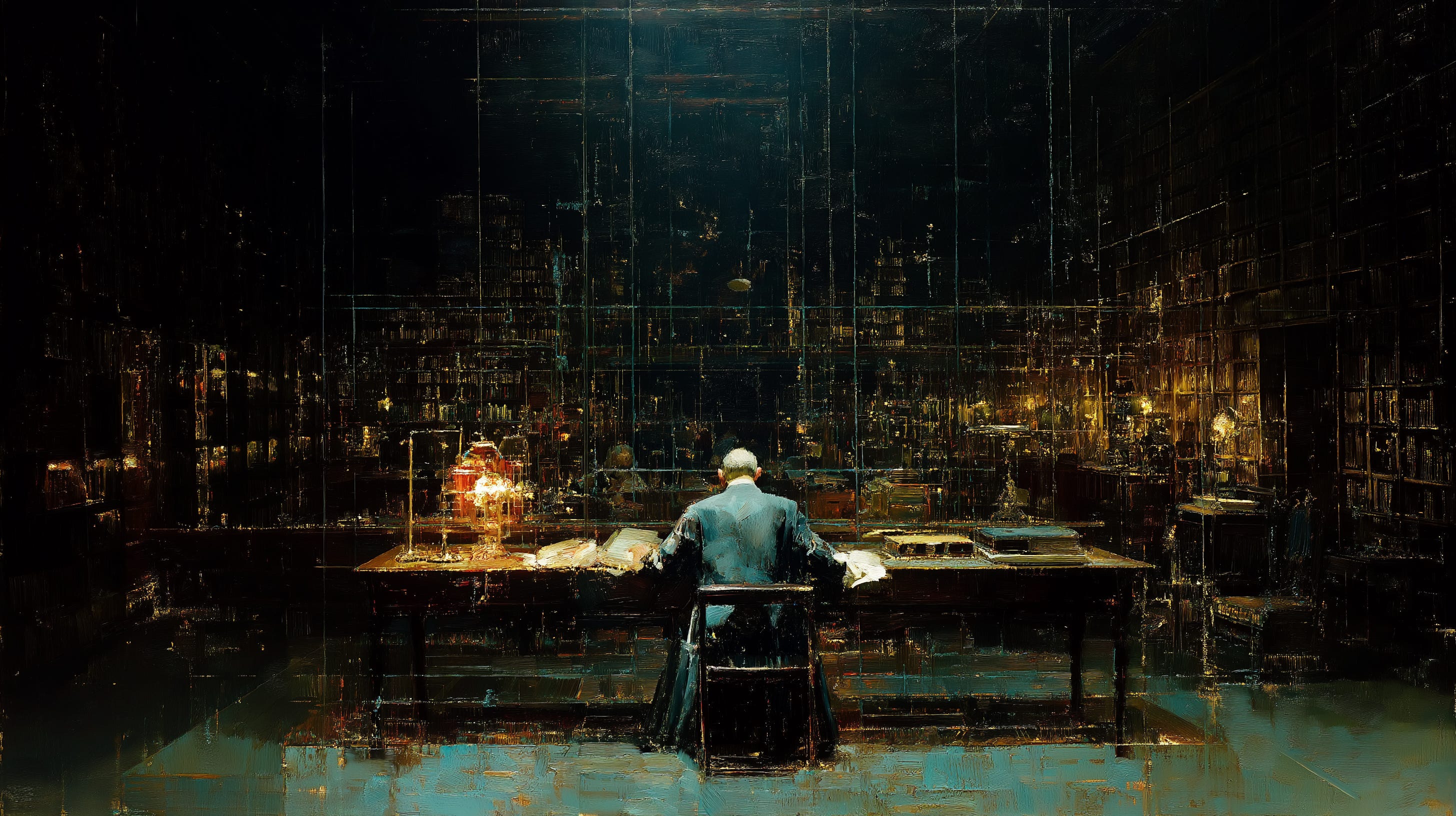
Back in 2023, I sat down to write a sales page for a client. I opened a blank document, looked at the cursor, and realized I couldn’t remember the last time I had stared at a blank page.
I write constantly, so it wasn’t for lack of writing. Somewhere in the past few years the blank page had stopped being blank, because there was always a starting point now, a prompt or a generation away. The emptiness that used to greet me and demand something from me before anything could exist had a trapdoor in it.
I sat there for a while, not writing, trying to remember what the old blankness felt like and what it felt like before you’d said anything:
What do you have to say? Do you have anything at all?
I couldn’t quite get back to it. The feeling was like trying to remember a dream you know happened and you know mattered, but the details and the texture are gone.
I’ve been working with generative AI since 2019, GPT-2 first, then GPT-3, then everything that followed. I was an early adopter and an enthusiast who has built workshops around it and advised companies on it, and I watched it multiply the options in front of me and compress timelines that used to stretch for days into hours.
I like this technology and I want it to work. I’ve watched AI deliver real value to businesses and to people, and it will keep doing that in ways we can barely imagine.
For a couple of years now I’ve been noticing something underneath the capabilities and the productivity gains and the debates about whether AI will take our jobs. What I notice is a change in me, in how I think and how I make things, and in what happens when the work gets hard, which is that I sometimes can’t remember what hard used to feel like.
Everyone is wondering whether AI will take our jobs. People argue about whether it creates or imitates, and about how much of it we should regulate. These debates are everywhere and they don’t stop, and all of them are about outputs: what AI produces, and what happens to human products when AI can produce them too.
Marshall McLuhan, the media theorist who saw further than almost anyone into how technologies reshape us, would say we’re missing the environment.
McLuhan spent his career pointing out that when a new technology arrives, we focus on what it carries, the content, while the technology itself reshapes everything around us without our noticing. “We don’t know who discovered water,” he liked to say, “but we’re pretty sure it wasn’t a fish.” Environments escape us because they’re everywhere, and we look through them on the way to looking at something else.
Creativity, jobs, authenticity: those are arguments about content. The environment is the thing doing the reshaping while we argue, and it works at the level of experience, on what thinking feels like and what making feels like and what happens in you when the work gets hard. Being inside it is what makes it hard to see.
I’ve been inside it for seven years now and I’m still trying to notice what’s changed in the texture of my experience, and take inventory.
The Method
Andrew McLuhan, Marshall’s grandson, has been teaching the family method to those willing to learn. I’ve been studying with him, trying to understand how to perceive what normally stays invisible. The method itself takes one line: observe, notice, record, and hold off on conclusions for as long as you can stand it. You start from the certainty that you’re missing things, because you are.
“What am I missing?” is the governing question, and Andrew means it as a discipline of attention that you practice.
McLuhan Sr. called this inventory. You gather effects first and theorize causes later, which means noticing what’s happening before you decide what it means. He compared it to the detective story, and to Poe’s Dupin in particular, where you’re handed effects, a body, a crime, and you go looking for clues. Dupin’s discipline is to withhold the conclusion until the evidence is in.
He was specific about what the evidence would consist of. At the end of the 1965 essay, after eight pages on why environments escape notice, he wrote:
“New environments reset our sensory thresholds. These, in turn, alter our outlook and expectations. The need of our time is for the means of measuring sensory thresholds and of discerning exactly what changes occur in these thresholds as a result of the advent of any particular technology.”
Sixty years later, as far as I can tell, nobody built the instrument. What follows is an attempt with the only one I have, which is a single person’s attention turned on his own experience.
The method matters now because we’re inside a transition. Most people only perceive what a technology did to them after it’s been displaced by the next technology. McLuhan called this “rear-view mirror” thinking. We understand radio only once television has made it obsolete, which leaves us permanently one phase behind.
Taking inventory from inside the environment yields traces and clues. The whole picture stays out of reach for as long as we’re in here, and the traces might still be enough to tell us that something is happening before we can say what.
McLuhan was less pessimistic about this than I am, and his reason belongs next to mine. An environment escapes observation, he argued, because it runs at low definition. Raise its intensity and it turns into something you can look at: “Anything that raises the environment to high intensity, whether it be a storm in nature or violent change resulting from a new technology, such high intensity turns the environment into an object of attention.” Then he contradicts my hedge outright: “In an age of accelerated change, the need to perceive the environment becomes urgent. Accelerated change makes such perception of the environment more possible.”
Speed is supposed to be the thing that blinds us, and he thought it was the thing that gave us a chance, on the grounds that a fast environment is a loud one and loud environments can be heard. Whether he was right is what this essay is testing.
You have heard a version of this before. Every technology that touched writing produced writers who said it changed them, and they were usually wrong about how. When word processors arrived, William Zinsser assumed that writing at a terminal “would involve whole new mental processes” and would leave his prose mechanical. What he reported afterward was that “it seemed quite natural.” From here, the people who worried look like people who couldn’t tell a tool from a threat.
Anne Rice, a few years into using one, said this: “Once you really get used to a computer and you get used to entering the information from that keyboard, things happen in your mind, I mean, you change as a writer.” That’s a report of what happened to her, and the change she and others described was structural. Matthew Kirschenbaum, who wrote the literary history of the word processor, puts it this way: at a typewriter “we are always in the present moment as the carriage trundles forward character by character, line by line,” while word processing “allowed writers to grasp a manuscript as a whole, a gestalt.”
Almost nobody saw that while it was happening, and it took fifteen years and a generation of scholarship to describe it, which is the rear-view mirror working exactly as advertised.
One difference matters, and I’d rather put it up front than have it used against me later. The word processor changed how I handled my own text, whereas this changes who else is in the room, and the parallel stops being useful right there.
What follows is what I’ve noticed changing in my own experience over seven years of working with AI daily, across hundreds of projects for dozens of clients. Writing is where I see it most clearly because writing is the domain I know best, though what I’m describing is bigger than writing. It’s what happens to a person who thinks and makes and gets stuck inside this environment.
The Inventory
Beginning
In 2018, I took on a project for a SaaS company. They needed a full launch sequence: emails, landing pages, ads, the works. I remember sitting in my office on the first morning, coffee going cold, staring at the brief. Three hours passed before I wrote a single word, and those three hours were the thinking, turning the problem over and letting the shape of it settle before I tried to give it language.
That was how it always worked. The blank page was a demand that something come from you before anything could exist. Writers talk about the terror of the blank page as though it belonged to them, though the same weight sits at the front of any project and any problem you’re about to think through, and that weight is what has gone, because a starting point is always available now.
A few months ago, I took on a SaaS project. This one was about using AI tools for analysis, so about the same complexity. I opened Claude and typed a prompt describing what I needed. Forty-five seconds later, I had a first draft of a positioning framework. It wasn’t right, but it was something, and the blankness was gone.
I finished much faster than I would have in 2018, with good output and a happy client. But something was missing from the process and it took me weeks to work out what: I never sat with the emptiness, because I never had to. I had skipped the confrontation that used to happen at the beginning, where something had to come from me before anything could exist.
I don’t know what that confrontation was doing for me, and I notice its absence anyway.
Your Own Output
The shitty first draft was a concept before AI. Anne Lamott gave writers permission to write badly as a way toward writing well. The concept assumed the draft was yours, your mess and your raw material, your thoughts taking shape through your own effort.
When AI generates the first draft, you start in a different position. You’re responding to something else’s attempt at what you asked for, which makes you an editor before you’re a creator.
Vauhini Vara wrote about using GPT-3 to approach her sister’s death, a topic she couldn’t face directly. She describes the process as writing against what the model produced, defining herself in opposition to it. Talking about it afterward, she put it harder: “I’m asserting my own consciousness by writing against what GPT-3 has produced.” By the end of the nine attempts, “I’ve taken control of the narrative.”
I know that feeling of writing against something now. The model gives you something and you push back on it, revising and rejecting until it turns. The output still ends up yours, and the process of getting there has a different structure.
My first drafts used to be bad in a way that felt like me at my worst, clumsy and trying too hard. The bad drafts I get now are smooth and plausible and somehow not mine, so I have to work to make them mine, pushing against their competent blandness until something with edges comes out.
I don’t know whether editing someone else’s draft builds what generating your own built, or whether it feels the same in the body, and I notice the difference anyway.
Not-Knowing
Being stuck used to be a wall, where you came up against the limits of your own knowledge and imagination. You didn’t know, and you had to sit with not-knowing until something shifted.
I remember a project in 2017 where I spent three days trying to crack a positioning problem and nothing worked. I went for walks and took showers and woke up early with half-formed ideas that dissolved within minutes. On the fourth day something clicked, and I still don’t know why that day and not the day before. The answer came, and it was mine, and I knew it was right because I had earned it through the not-knowing.
Being stuck has a different shape now. Last year I hit a wall on a client brief, the same kind of problem: positioning, differentiation, the core strategic question. I sat with it for maybe twenty minutes, then opened Claude and described what I was struggling with. The response wasn’t the answer, though it gave me three angles I hadn’t considered, and one of them led me to the solution.
I got unstuck faster and the output was good, and I skipped something on the way. The blankness that used to accompany not-knowing has a trapdoor in it now, so escape is always available.
Sometimes I take the trapdoor and sometimes I stay, though I always know it’s there, which is what has changed about not-knowing: the finality has gone out of it.
Something used to happen in the old not-knowing, when you sat with an absence you had no way around except through your own effort. I can’t prove it happened or say what it was, and I notice I’m in that place far less often now.
Prompt-Shaped Thinking
I’m less confident about this one, and I’ll report it anyway. Working with AI daily for seven years, I’ve noticed my mind starting to formulate thoughts in terms of what I could ask for. Before I open the interface I’m already shaping the request. My cognition is becoming prompt-shaped.
I catch myself doing it in the shower and in the middle of conversations. The thought comes: I could prompt that. And then the thought itself starts to take the shape of a prompt, even if I never type it.
This is environmental in McLuhan’s precise sense, where the medium reshapes the user. My mind is adapting to the interface, learning to produce inputs the system can take.
Prompt-shaped cognition favors the thought that arrives as a clear request and decomposes into a query. What gets harder to hold is the vague intuition, the thought that doesn’t yet know what it’s asking for.
I used to have more thoughts I couldn’t articulate, hunches and things I knew but couldn’t say, and now they arrive more fully formed and readier to be prompted, which could be maturity and could be loss.
Selection
AI produces ten versions in seconds, which frees you from the single attempt. Text, images, code, ideas: more is always available than you could use.
Abundance creates its own problem, because choosing is now the job, and choosing means knowing which of the ten is best and which direction it opens. Generating has moved off my desk while discerning stayed.
Ted Chiang would stop me right here. Art, he writes, is “something that results from making a lot of choices,” and a ten-thousand-word story takes something on the order of ten thousand of them. Give a model a hundred-word prompt and you have made a hundred. Chiang reads that gap as a disqualification: “The selling point of generative A.I. is that these programs generate vastly more than you put into them, and that is precisely what prevents them from being effective tools for artists.” Choices happen at every scale, he argues, and the small ones carry as much weight as the large. Whatever survives the trip from prompt to output has had its intention thinned.
He’s right about art, and it doesn’t answer the question I’m asking. Chiang is asking what a work needs in order to be good, and I’m asking what happens to the person at the keyboard, which is where our questions separate. The nine thousand nine hundred choices I no longer make may well be the reason the output is thinner than it looks, which is his point. Those same choices were also my working day and my practice, and selecting among ten finished options is a different activity that now fills hours at a stretch.
My observation stays narrow: the ratio has moved, and the faculty I exercise most has gone from generating to discerning. Chiang doubts that discernment can carry the weight generation used to carry, and I’m being asked to find out in public, at speed, without having agreed to the experiment.
I wrote about taste and discernment in “The Revenge of Beauty,” before I understood the question would arrive from this direction.
The Plateau
AI output reaches competence fast. It comes back coherent and plausible, better than a weak human first attempt, and acceptable in a great many contexts. Someone decides it’s acceptable, and that someone is me.
I wrote a whole issue about this once and called it Threshold Intelligence, the judgment that tells you when good enough is good enough and when polish has turned into fussing. I described it as a faculty you develop, and it is one. A threshold can also be moved from the outside, which I hadn’t considered.
The old mechanism was cost. Producing anything at all was expensive, so once I had paid that price I was invested, and I would keep going past the first acceptable version because I was already standing in it. The friction and the motivation were tangled together and I could not have told you which was which.
Now the first acceptable version arrives in forty-five seconds and costs me nothing. Going past it is a pure expense with no sunk investment behind it, so I have to choose to push, deliberately, every time, against a default that says stop here, and I make that choice sometimes and skip it often.
The faculty is still mine while the setting has moved out of my hands. Something recalibrated my sense of sufficiency while I was busy admiring the speed, and I caught it only because I’d spent a year writing about the faculty it recalibrated.
Productive Struggles
Some difficulties were obstacles and nothing more, and others did something to me, though telling them apart took years.
I’m thinking of fighting a problem until it yields, of finding out what I think by failing to say it, of the skill that comes from hitting your own limits with no way around them. I’m about to stop reporting and start concluding, and I’d rather admit that than smuggle it past you. The inventory tells me those struggles are gone and stays silent on what they were for. What comes next is belief and I’ll label it as belief: those struggles were how I developed as a writer and as a person.
Robin Sloan was experimenting with AI writing tools years before ChatGPT, and he wanted something other than what we got. “The goal is not to make writing ‘easier’; it’s to make it harder,” he wrote. “The goal is not to make the resulting text ‘better’; it’s to make it different, weirder, with effects maybe not available by other means.” The environment we ended up inside went the other way and gave us ease and speed and less friction, some of which turned out to be load-bearing.
A study of fanfiction communities found that 51.9% of the 156 readers and writers surveyed were concerned that AI use “would lead to a loss of the writing experience as a personal journey.” One of them put it this way: “We are in the fandoms because of the warmth, I don’t need to feel like a machine is cuddling me. It’ll probably starve my soul without me even realizing it.”
Without me even realizing it. That last clause is the environmental effect, described by someone standing in it.
Scarcity
Even when I’m not using AI I know that I could, and the knowledge changes things. I hold what I’ve made more loosely now, because more of it is always available. My specific output stays unreproducible while output in general has become abundant, and that changes the context I make anything in.
McLuhan, in a 1973 seminar, said: “Pattern recognition takes over from all previous package deals. The consumer age is over for everybody.” Consuming scarce outputs has given way to recognizing patterns in a world of infinite generation, and what we value and how we value it are both moving underneath us.
I notice this most in how I meet other people’s work. Something human-made now prompts me to ask whether it had to be human-made, and whether a model could have produced it instead. The question wouldn’t have occurred to me a few years ago and now it’s part of how I perceive.
Andrew put the abundance problem back in the body, which is where I should have been looking. Too much information, for a person, is an overload condition that gets uncomfortable and then shuts you down, and one consequence of that is PTSD. An agent has no such limit, he said, and for them it’s bring it on, the more the merrier. Underneath that is appetite, and underneath appetite, the question of where it ends: “Where does consumption end? I get full. I’m not hungry anymore. But it tastes so good. I would like some more.” My satiety threshold is a limit the thing I work with doesn’t have.
McLuhan, in that same seminar, was tracking a scarcity I hadn’t considered. Electric speed, he said, “deprives most people of their identity. Most people are just, will not be able to have any identity, whatever.” Then he made it worse: “Violence, of course, is the scramble for identity when it’s scarce.” I don’t know yet what to do with that. I’m writing it down because the method says write down what you notice, and what I notice is that the scarcity he’s tracking is identity.
The Patterns I’m Starting to See
Nearly every effect on this list operates at the level of experience, on what thinking and making feel like from inside, and on how you stand toward your own mind.
The current debates work at the level of outputs: text quality, job displacement, economic impact. Those are real concerns, and the change I’m describing is happening somewhere more interior and harder to measure, to us, while we argue about our products.
Analysis can’t perceive the environment, because analysis runs on categories and the environment has already reshaped the categories. We ask whether AI-generated text is as good as human text, when what has changed is what producing text feels like. The same trap sits under the question about creative jobs. The thing we’re trying to measure has already bent the instrument.
The body is missing from nearly all of this. Most discussion of AI treats a human as a cognitive system of inputs and outputs, prompts and responses, which erases the physical side of thinking and making. Being stuck has a feel: the restlessness, the sense of something not yet formed pressing to get out, and then the release when it comes clear. Difficulty happens in the body before it happens anywhere else.
McLuhan had already named the condition. In that 1973 seminar he told the room that at electric speed a person loses his body: “you are literally discarnate and minus bones and flesh when you’re on radio, television, telephone, or any electric medium. So you can be many places at once electrically.” He was describing a telephone, and the thing I’m describing answers back.
My grandfather spent decades on a dairy farm. He knew every stone in his fields and every sound his equipment made when something was going wrong, and that knowledge lived in his hands and his back, where you couldn’t pry it loose from the body holding it.
Struggle is optional now and the body’s part in wrestling a problem can be skipped, and what that does to us as embodied creatures is the question I can’t answer. It isn’t a new question either. McLuhan asked a version of it in 1973 and almost nobody followed him. Fifty years on, the conversation about AI has examined nearly every part of this technology except the part of us that has a body.
The Open Question
If the effects are experiential, if they operate at the level of the sensorium, the felt texture of being human, what would it take to perceive the environment producing them?
Analysis won’t get us there, because we can’t think our way out of something that is reshaping how we think.
McLuhan’s term for the solution was “anti-environment,” and his 1965 essay states the problem it exists to solve: “The ground rules, the pervasive structure, the overall pattern eludes perception except in so far as there is an anti-environment or a counter-situation constructed to provide a means of direct attention.”
Art had traditionally done that work. “The artist provides us with anti-environments that enable us to see the environment,” he wrote, and in Understanding Media he had put it harder: the artist is “the man of integral awareness.” He also warned that the trick wears off. Anti-environmental means of perception “must constantly be renewed in order to be efficacious.”
Andrew gave me the working version in the first letter he wrote me, dated the Feast of the Epiphany. An anti-environment, he said, is anything which makes visible the invisible, or helps us notice something we miss, like dye in a stream. Then he added that it can be as simple as asking “what am I missing?”
I had been asking that question through this whole inventory as a discipline of attention, a way of staying honest while gathering effects. Andrew was telling me it’s also the smallest anti-environment there is, which makes the question itself the dye.
What would a larger one look like, built for effects this hard to see? I have the beginning of an answer, and the rest of it belongs to a different essay. The inventory is an anti-environment.
If the effects are experiential, an anti-environment for them has to work at the same level, felt before it’s argued, revealing through direct perception.
Discernment is part of the answer, the capacity to perceive quality and to feel where the life is in a thing. Taste works as an anti-environment, which makes beauty the dye in the stream.
What Am I Missing?
I’ve reported what I found. It’s partial, biased toward writing and copywriting, shaped by one person’s seven years inside this technology. The inventory stops short of finished, and finishing it is beyond one person.
So, what are you noticing? Tell me what’s changed in how you begin things and where you get stuck, and what’s different in the felt texture of being you.
McLuhan was blunter than I’ve been about the cost of not asking. Our habit, he wrote, is to rebuild the old environment instead of noticing the new one, and he named the price: “This failure leaves us in the role of automata merely.” I’m taking inventory, and I’d like company.
Talk again soon,
Samuel Woods
The Bionic Writer